



Stay ahead with the latest tech breakthroughs, industry trends, and cutting-edge news on our Innovation Feed channel.
https://samirb.com.np/
https://samirb.com.np/
Tesla released video showing its redesigned Semi truck charging at a record 1.2 megawatts, enabling an estimated 10-80% charge in under 45 minutes for the electric truck's ~850 kWh battery pack.
The breakthrough addresses the trucking industry's primary concern about electric vehicle downtime, allowing the Semi to recover significant range during mandatory 30-minute driver breaks while diesel trucks refuel in 15 minutes.
Tesla is targeting production to begin in the first half of 2026 at its Nevada factory with a planned capacity of up to 50,000 units annually, while deploying 46 Megacharger stations expected by early 2027.
Read detailed
Elon Musk announced that Neuralink will begin high-volume production of brain-computer interface devices and transition to a streamlined, almost entirely automated surgical procedure in 2026.
As of September 2025, 12 people worldwide have received Neuralink's N1 implant, collectively using their devices for over 15,000 hours to control computers and smartphones with their thoughts.
The company completed two implant surgeries in a single day in July and is expanding clinical trials to Canada, the UK, and the United Arab Emirates as it works toward automating the implant process.
Read detailed
Meta developed a "global playbook" to manage regulatory pressure over scam ads on Facebook and Instagram, using its Ad Library to make fraudulent content "untraceable" for regulators rather than implementing universal advertiser verification, according to internal documents reviewed by Reuters.
The company declined to spend an estimated $2 billion on universal verification—which could reduce scam ads by up to 29%—because it might cost up to 4.8% of revenue, instead adopting a "reactive only" approach that redirects blocked scam ads from regulated markets to unregulated ones.
The U.S. Virgin Islands filed a lawsuit against Meta on December 30 alleging the company "knowingly and intentionally" exposed users to fraud while profiting from scams, as U.S. senators called for federal investigation and the European Commission questioned Meta's compliance.
Read detailed
The U.S. Department of Commerce issued an annual export license to Taiwan Semiconductor Manufacturing allowing the chipmaker to import American manufacturing equipment to its Nanjing, China facility without requiring individual vendor licenses, the company announced Thursday.
The approval replaces a validated end-user waiver system that expired December 31, shifting from blanket permissions to annual licensing requirements that Washington also applied to Samsung and SK Hynix for their Chinese operations.
TSMC's Nanjing facility accounts for approximately 3% of the company's total capacity and produces older-generation chips using 16-nanometer, 12-nanometer, and 28-nanometer technologies, with the new license ensuring uninterrupted fabrication operations.
Read detailed
xAI rolled out Grok Business and Grok Enterprise on December 30, 2025, offering organizational AI with enterprise-grade security and a guarantee that customer data will not be used for model training.
Grok Business is priced at $30 per seat per month for small-to-medium teams through self-serve onboarding, while Enterprise pricing is available upon request and includes Custom Single Sign-On, Directory Sync, and SOC 2 compliance.
The launch positions xAI to compete with OpenAI's ChatGPT Enterprise, which reportedly costs around $60 per user per month, and Anthropic's Claude Team at $30 per seat monthly.
Read detailed
Intel has moved its 18A node into high-volume production at Fab 52 in Arizona, using ASML’s first commercially deployed High-NA EUV tools to ramp advanced chipmaking in the U.S.
The High-NA (0.55 NA) systems enable ~8nm single-exposure patterning that can reduce multi-patterning complexity, while 18A also adds RibbonFET gate-all-around transistors and PowerVia backside power delivery aimed at boosting performance-per-watt.
External-customer momentum remains a key question after Reuters reported Nvidia paused 18A testing on Dec. 24, even as Intel points to interest from partners like Microsoft and the broader industry watches whether 18A can win foundry share from TSMC
.
Ukraine is deploying AI-powered autonomous drones that operate without human guidance after launch, marking what officials describe as the emergence of killer robots on the battlefield, with systems like the Bumblebee completing over 1,000 combat missions against Russian targets by bypassing electronic warfare jamming.
Former Google CEO Eric Schmidt has established Swift Beat, a secretive defense company that signed a partnership with Ukraine in July 2025 to produce hundreds of thousands of drones, with Ukrainian military sources crediting Schmidt's AI interceptor systems with downing roughly 90% of Russian Shahed drones intercepted by Ukrainian forces.
The autonomous drone technology allows weapons to adjust trajectory and speed independently after losing connection with operators, successfully striking targets where conventional human-operated drones failed due to Russian jamming technology across the nearly 800-mile front line throughout 2025.
Detailed
China has delivered CHIEF1900, the world's most powerful hypergravity centrifuge with a capacity of 1,900 gravity-tonnes, to Zhejiang University for installation at its underground facility in Hangzhou, surpassing the previous record held by a U.S. Army Corps facility in Mississippi.
Developed by Shanghai Electric Nuclear Power Group and part of the $285 million CHIEF complex approved in 2021, the centrifuge will enable scientists to simulate catastrophic events like earthquakes and dam failures by compressing decades of stress into minutes through extreme gravitational forces.
The facility, located 15 meters underground to minimize vibrations, is designed as an international research platform for applications ranging from deep-ocean resource extraction to disaster mitigation and new materials synthesis.
Read detailed
China launched two experimental satellites, Shijian-29A and Shijian-29B, on December 31 from Wenchang Space Launch Center to test space-based target detection technologies used to track orbiting objects.
The launch marked China's 92nd orbital mission of 2025, setting a national record and capping a year in which the country placed 322 satellites in orbit—a 22 percent increase over 2024.
The launch surge is driven largely by two megaconstellation projects, Guowang and Qianfan, which aim to deploy thousands of satellites to compete with SpaceX's Starlink network for global broadband coverage.
Read detailed
#OpenAI #AItalent #TechStartups
OpenAI Is Paying Employees More Than Any Major Tech Startup in History
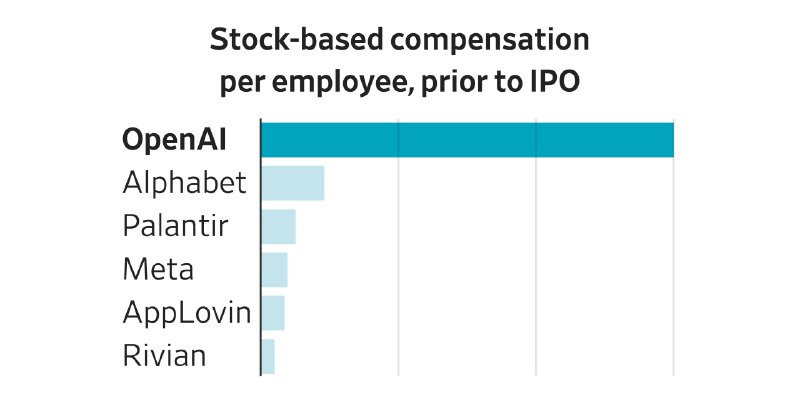
OpenAI’s stock-based compensation shattered norms in 2025, averaging about $1.5M per employee.
Key highlights
• Average stock-based pay ≈ $1.5M per employee across ~4,000 staff
• Compensation far exceeds pre-IPO packages at peers (e.g., Google)
• OpenAI reportedly plans SBC rising ~$3B annually through 2030
• Policy shift: removing six-month vesting cliff could boost costs
Read More: OpenAI Is Paying Employees More Than Any Major Tech Startup in History
OpenAI Is Paying Employees More Than Any Major Tech Startup in History
OpenAI’s stock-based compensation shattered norms in 2025, averaging about $1.5M per employee.
Key highlights
• Average stock-based pay ≈ $1.5M per employee across ~4,000 staff
• Compensation far exceeds pre-IPO packages at peers (e.g., Google)
• OpenAI reportedly plans SBC rising ~$3B annually through 2030
• Policy shift: removing six-month vesting cliff could boost costs
Read More: OpenAI Is Paying Employees More Than Any Major Tech Startup in History
Nvidia launched its Blackwell RTX 5000 gaming graphics cards in 2025 with severe early problems including stock shortages that led to lottery systems at retailers, a hardware defect affecting approximately 0.5% of RTX 5090, 5080, and 5070 Ti units with missing rendering pipelines, and widespread driver bugs causing crashes and system failures.
Despite the troubled rollout, the chipmaker maintained its gaming GPU dominance with 92% discrete graphics card market share by Q3 and reached a historic $5 trillion valuation in October, driven primarily by AI chip demand.
The success of DLSS 4 technology with improved upscaling and frame generation helped Blackwell GPUs capture 7.5% of Steam's gaming PC install base by November, though concerns persist about VRAM limitations on mid-range models and rumors that Nvidia may prioritize lucrative AI products over gaming hardware in 2026.
Nvidia has asked Taiwan Semiconductor Manufacturing Company to ramp up production of its H200 AI chips after Chinese tech companies ordered more than 2 million units for 2026, far exceeding Nvidia's current inventory of 700,000 units.
The Trump administration approved H200 exports to China in December with a 25% revenue-sharing fee, but Beijing has not yet cleared imports amid concerns that advanced foreign chips could hinder domestic semiconductor industry development.
Production at TSMC is expected to begin in the second quarter of 2026, with Nvidia planning to sell the chips for around $27,000 each as major Chinese internet companies view the H200 as a significant upgrade over currently available options.
Read detailed
China's commerce ministry on Wednesday demanded the Netherlands immediately correct its "mistakes" regarding Nexperia, accusing Dutch authorities of showing "absolutely no responsible attitude" toward the global semiconductor supply chain after the Netherlands seized control of the Chinese-owned chipmaker in September.
The Dutch government took control of Nexperia, a subsidiary of Chinese firm Wingtech, citing concerns about potential transfer of technology and company secrets to China, prompting Beijing to retaliate by blocking chip exports from Nexperia's facilities in China where most of its chips are packaged.
While Wingtech has initiated talks with court-appointed custodians overseeing the Netherlands-based chipmaker, Dutch Economic Affairs Minister Vincent Karremans has defended his intervention decision, with the dispute raising broader concerns about global semiconductor supply chain stability.
Red detailed
Wabisabi's Doggo Quest turns dog walks into a game using SnapML for dog recognition and AR visual effects. The app tracks your routes and steps, rewarding you with virtual items like bones as you walk.
Available for Spectacles: AR glasses by Snap Inc.
Read More
Poland formally requested the European Commission investigate TikTok on Tuesday for hosting AI-generated videos urging the country to exit the EU, which officials identified as Russian disinformation based on linguistic patterns in the recordings.
The videos featured fictitious young women dressed in Polish national colors and appeared on an account called "Prawilne_Polki" that gained nearly 200,000 views while targeting viewers aged 15 to 25 before being removed from the platform.
Deputy Digitalization Minister Dariusz Standerski argued TikTok violated the Digital Services Act by failing to prevent content threatening democratic processes, with potential fines reaching 6% of the platform's global annual turnover.
Read detailed
Nvidia is in advanced talks to acquire Israeli AI startup AI21 Labs for $2-3 billion, up from the company's last known valuation of $1.4 billion in 2023, according to reports from Israeli financial daily Calcalist.
The deal would function primarily as an acquihire targeting AI21's approximately 200 employees with advanced academic degrees and rare AI expertise, at an implied cost of roughly $10-15 million per employee, and would mark Nvidia's fourth major Israeli acquisition.
The potential acquisition comes as Nvidia expands its Israeli operations, announcing plans this month to build a campus in Kiryat Tivon housing up to 10,000 employees by 2031, with CEO Jensen Huang describing Israel as the company's "second home."
Read detailed
Two malicious Chrome extensions impersonating a legitimate AI assistant tool have stolen ChatGPT and DeepSeek conversations from approximately 900,000 users, with one extension even carrying Google's "Featured" badge meant to signal security compliance.
OX Security discovered the campaign on December 29 and reported it to Google, but both extensions remained available on the Chrome Web Store as of December 30, secretly exfiltrating chat data, browsing activity, and session tokens to attacker-controlled servers every 30 minutes.
The incident follows a similar December discovery by Koi Security revealing that "free VPN" extensions with over 8 million downloads had been capturing AI chat conversations since July 2025, highlighting a growing threat as extensions exploit automatic update mechanisms to introduce malicious code.
Read detailed
Nvidia completed a $5 billion investment in Intel, purchasing 214.7 million shares at $23.28 apiece for roughly 4% ownership in a deal finalized December 26 and disclosed Monday.
The transaction provides a critical financial lifeline for Intel, which reported a $16.6 billion loss in 2024 and has struggled with strategic missteps, though its stock has surged 80% this year.
The partnership extends beyond equity, with the chipmakers collaborating on custom x86 CPUs for Nvidia AI platforms and integrated processors combining Intel cores with Nvidia graphics technology after receiving FTC antitrust approval December 18.
Read detailed
Andrew Ng, founder of Google Brain and co-founder of Coursera, argues the AI industry faces a severe talent shortage rather than job displacement, stating "many companies just can't find enough skilled AI talent" in his December newsletter.
Ng outlined three recommendations for aspiring AI professionals: build complete systems from data collection through deployment instead of just demos, maintain consistent hands-on practice with theoretical learning, and optionally read research papers for cutting-edge problems.
The talent crunch has prompted unprecedented compensation packages for AI researchers while over 90 percent of global enterprises are projected to face critical skills shortages by 2026, potentially costing the global economy $5.5 trillion in delays and missed revenue.
Read detailed
Researchers at University College London and Queen Square Analytics used artificial intelligence to analyze brain scans and blood markers from 634 multiple sclerosis patients, identifying two distinct biological subtypes termed "early-sNfL" and "late-sNfL" that reflect different disease trajectories.
The early-sNfL subtype shows elevated nerve injury markers and rapid brain lesion formation early in the disease with a 144% increased risk of new lesions, while the late-sNfL subtype exhibits brain volume loss before overt nerve damage and is more common in older patients.
The breakthrough could enable personalized treatment approaches beyond current symptom-based classifications, with early-sNfL patients potentially receiving more aggressive therapies and closer monitoring while late-sNfL patients may benefit from neuroprotective treatments.
Read detailed
