



Stay ahead with the latest tech breakthroughs, industry trends, and cutting-edge news on our Innovation Feed channel.
https://samirb.com.np/
https://samirb.com.np/
Telegram founder Pavel Durov announced he will pay for in vitro fertilization (IVF) for unmarried women aged 37 or younger who use his sperm. The 41‑year‑old billionaire, who has already fathered over 100 children, calls the offer a way to help solve the global fertility crisis.
The program is managed by Moscow's Altravita Clinic, which promotes it as a unique chance to use donor material from a famous entrepreneur. Durov is covering the full cost of the treatments, which usually run around $5,000.
What do you think?
❤️ — Marketing
🔥 — He's just... being Pavel!
Read More
The AI robot Olaf from Frozen now greets guests at Disneyland Paris. Its smooth, realistic movements are the result of reinforcement learning and Nvidia technologies.
The robot is trained in a simulation, where it learns to accurately reproduce movements crafted by animators.
Read More
We'll see the return of the original Captain America now revealed to have a child with Peggy Carter (Hayley Atwell, also back), following the time-displaced romance they sealed with a kiss at the end of Endgame.
How this shapes the plot remains unclear, but given the subtitle, it's unlikely the Rogers family's future will be a happy one.
"Avengers: Doomsday" hits theaters on December 18, 2026, followed by "Avengers: Secret Wars" on December 17, 2027.
MiniMax M2.1 was officially announced, scoring 72.5% on SWE-multilingual.
"A SOTA 10B-activated OSS coding & agent model, scoring 72.5% on SWE-multilingual and 88.6% on our newly open-sourced VIBE-bench"
"A SOTA 10B-activated OSS coding & agent model, scoring 72.5% on SWE-multilingual and 88.6% on our newly open-sourced VIBE-bench"
#AI #ChatGPT #YearInReview
ChatGPT Launches a Year-End Review Like Spotify Wrapped
OpenAI's ChatGPT is rolling out "Your Year with ChatGPT," a fun, personalized recap of your 2025 interactions, inspired by Spotify Wrapped's catchy vibes.
This lightweight feature hands out custom "awards" like "Creative Debugger" based on your chats, plus a poem and image tailored to your interests—keeping things privacy-focused with opt-in controls.
Key highlights
⦁ Available now to free, Plus, and Pro users in the US, UK, Canada, Australia, and New Zealand who enable chat history and memories—no teams or enterprises yet.
⦁ Access it via the app home screen, web, iOS/Android, or just ask ChatGPT directly; it's not auto-launched to respect your space.
⦁ Highlights top topics, habits, and styles without sharing data externally, making it a shareable reflection on how AI boosted your year.
⦁ Teases future expansions, especially with ChatGPT's 2026 adult content support, for even wilder personal summaries.
⦁ Perfect for tech enthusiasts: It's a clever way to visualize AI usage patterns and spark ideas for next year's prompts.
Read More: TechCrunch Article
ChatGPT Launches a Year-End Review Like Spotify Wrapped
OpenAI's ChatGPT is rolling out "Your Year with ChatGPT," a fun, personalized recap of your 2025 interactions, inspired by Spotify Wrapped's catchy vibes.
This lightweight feature hands out custom "awards" like "Creative Debugger" based on your chats, plus a poem and image tailored to your interests—keeping things privacy-focused with opt-in controls.
Key highlights
⦁ Available now to free, Plus, and Pro users in the US, UK, Canada, Australia, and New Zealand who enable chat history and memories—no teams or enterprises yet.
⦁ Access it via the app home screen, web, iOS/Android, or just ask ChatGPT directly; it's not auto-launched to respect your space.
⦁ Highlights top topics, habits, and styles without sharing data externally, making it a shareable reflection on how AI boosted your year.
⦁ Teases future expansions, especially with ChatGPT's 2026 adult content support, for even wilder personal summaries.
⦁ Perfect for tech enthusiasts: It's a clever way to visualize AI usage patterns and spark ideas for next year's prompts.
Read More: TechCrunch Article

Manus introduced a new "Design View" flow on web and mobile to help you refine your images and ideas.
"It is an extension of the Manus agent, allowing you to commission, create, and refine visual assets as part of a single, seamless AI design workflow."
"It is an extension of the Manus agent, allowing you to commission, create, and refine visual assets as part of a single, seamless AI design workflow."
#AI #MusicTech #DataLeak
Spotify Leak Rumour: 256M Songs, But Who Has 300TB Storage?
A massive alleged scrape of Spotify's library by pirate activists has sparked buzz, but downloading 300TB of music data is a logistical nightmare for most.
Pirate group Anna’s Archive claims to have extracted metadata for 256 million tracks and 86 million audio files, totaling around 300TB, as a "preservation archive" shared via torrents.
Key highlights
⦁ The release covers 99.6% of Spotify listens, sorted by popularity, with metadata already out and audio files rolling out in stages—think playlists and extras coming soon.
⦁ Reality check: Grabbing this beast requires insane storage, bandwidth, and hardware; it's not a quick binge like your next Arijit Singh playlist.
⦁ Spotify's probing the breach, blaming third-party scraping of public data plus DRM bypass for audio access—no user accounts hit yet.
⦁ Bigger picture: This challenges streaming giants' control, but raises legal red flags for downloaders amid piracy crackdowns.
⦁ For tech fans, it's a wild reminder of data scale in music—perfect for debating open access vs. artist rights.
Read More: Siasat Daily Article
Spotify Leak Rumour: 256M Songs, But Who Has 300TB Storage?
A massive alleged scrape of Spotify's library by pirate activists has sparked buzz, but downloading 300TB of music data is a logistical nightmare for most.
Pirate group Anna’s Archive claims to have extracted metadata for 256 million tracks and 86 million audio files, totaling around 300TB, as a "preservation archive" shared via torrents.
Key highlights
⦁ The release covers 99.6% of Spotify listens, sorted by popularity, with metadata already out and audio files rolling out in stages—think playlists and extras coming soon.
⦁ Reality check: Grabbing this beast requires insane storage, bandwidth, and hardware; it's not a quick binge like your next Arijit Singh playlist.
⦁ Spotify's probing the breach, blaming third-party scraping of public data plus DRM bypass for audio access—no user accounts hit yet.
⦁ Bigger picture: This challenges streaming giants' control, but raises legal red flags for downloaders amid piracy crackdowns.
⦁ For tech fans, it's a wild reminder of data scale in music—perfect for debating open access vs. artist rights.
Read More: Siasat Daily Article

🧠🦠 Your gut may be shaping your mind more than you think
A new peer-reviewed study adds to the growing evidence that the gut microbiome plays a direct role in brain function, behavior, and mental health — far beyond digestion.
Researchers show that changes in gut bacteria can influence:
• 🧩 cognitive performance
• 😌 stress and anxiety levels
• 🧠 neuroinflammation and brain signaling
• 🔄 the gut–brain communication loop via immune and neural pathways
What’s especially striking is that the effects are bidirectional:
your mental state alters the microbiome, and the microbiome, in turn, alters your mental state.
This reinforces a major shift in neuroscience and medicine:
The brain is not an isolated organ — it’s deeply integrated with the immune system, metabolism, and trillions of microbes living inside us.
Implications range from mental health treatments to personalized nutrition, probiotics, and even preventive psychiatry.
📄 Source (open access):
https://www.tandfonline.com/doi/full/10.1080/19490976.2025.2599562
A new peer-reviewed study adds to the growing evidence that the gut microbiome plays a direct role in brain function, behavior, and mental health — far beyond digestion.
Researchers show that changes in gut bacteria can influence:
• 🧩 cognitive performance
• 😌 stress and anxiety levels
• 🧠 neuroinflammation and brain signaling
• 🔄 the gut–brain communication loop via immune and neural pathways
What’s especially striking is that the effects are bidirectional:
your mental state alters the microbiome, and the microbiome, in turn, alters your mental state.
This reinforces a major shift in neuroscience and medicine:
The brain is not an isolated organ — it’s deeply integrated with the immune system, metabolism, and trillions of microbes living inside us.
Implications range from mental health treatments to personalized nutrition, probiotics, and even preventive psychiatry.
📄 Source (open access):
https://www.tandfonline.com/doi/full/10.1080/19490976.2025.2599562
- After uploading an image, you can tap on it to make quick edits by sketching or adding texts (Image credit)
- SynthID can now also identify video content generated using Google AI (up to 100 MB and 90 seconds long)
In the US, UK, and Australia, about 35–39% of the population views AI negatively, according to a YouGov poll. The main fear is job loss: 66% of Britons are convinced that AI models will eliminate more jobs than they create. Notably, "AI pessimism" is most pronounced in English-speaking Western countries. On the other hand, 49% of people in Spain believe the benefits of implementing AI will outweigh the downsides.
Pew Research shows that residents of wealthier nations are much more aware of AI capabilities, yet anxiety levels remain high. For instance, half the US population is concerned about AI development—a sentiment shared by countries often considered outsiders in the "AI race," such as Italy, Australia, and Brazil.
In South Korea, only 16% express similar concerns, compared to 19% in India, 24% in Nigeria, and 30% in South Africa.
However, even in relatively wealthy nations like Sweden, Germany, and France, about a third of the population is worried about the technology's growth. The median percentage of "AI optimists" across countries is just 16%.
How do you feel about the rise of AI?
❤️ — Positive, I'm an AI optimist!
🔥 — Negative, I'm a skeptic!
🤔 — The main thing is that AI brings value...
#AI #Education #TechImpact
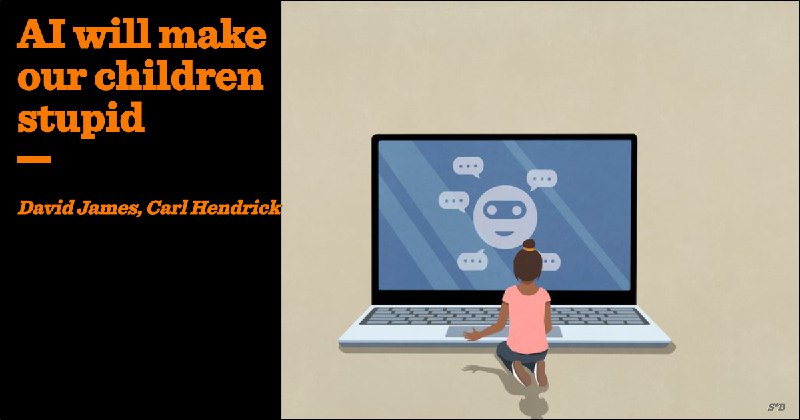
AI Will Make Our Children Stupid
As AI tools become everyday companions for kids, they risk stunting critical thinking and creativity by doing the mental heavy lifting for them.
The article warns that over-reliance on AI for homework, problem-solving, and even basic reasoning could leave a generation unable to think independently, much like calculators diminished mental math skills.
Key highlights
⦁ AI chatbots provide instant answers, discouraging kids from grappling with complex ideas or developing perseverance in learning.
⦁ Early exposure might weaken social skills, as virtual interactions replace messy, real human connections essential for empathy and collaboration.
⦁ Without thoughtful integration, AI could widen educational gaps, benefiting those with guidance while leaving others passive consumers of tech.
⦁ Authors urge parents and educators to prioritize human-led teaching to foster genuine intelligence over algorithmic shortcuts.
⦁ Long-term, this could reshape society, producing innovative users of AI but fewer original thinkers.
Read More: The Critic on AI and Kids
AI Will Make Our Children Stupid
As AI tools become everyday companions for kids, they risk stunting critical thinking and creativity by doing the mental heavy lifting for them.
The article warns that over-reliance on AI for homework, problem-solving, and even basic reasoning could leave a generation unable to think independently, much like calculators diminished mental math skills.
Key highlights
⦁ AI chatbots provide instant answers, discouraging kids from grappling with complex ideas or developing perseverance in learning.
⦁ Early exposure might weaken social skills, as virtual interactions replace messy, real human connections essential for empathy and collaboration.
⦁ Without thoughtful integration, AI could widen educational gaps, benefiting those with guidance while leaving others passive consumers of tech.
⦁ Authors urge parents and educators to prioritize human-led teaching to foster genuine intelligence over algorithmic shortcuts.
⦁ Long-term, this could reshape society, producing innovative users of AI but fewer original thinkers.
Read More: The Critic on AI and Kids
#AI #Programming #DevTools
Using AI Generated Code Will Make You a Bad Programmer
Relying too heavily on AI for code generation can erode core programming skills, turning devs into copy-paste experts instead of thoughtful builders.
⦁ AI tools like Copilot spit out quick fixes, but they often produce bloated, insecure code that ignores edge cases and best practices.
⦁ Over time, devs skip learning fundamentals, leading to unmaintainable projects riddled with subtle bugs from unvetted AI outputs.
⦁ It fosters laziness: Why understand algorithms when AI handles it? This hurts debugging and innovation in real-world scenarios.
⦁ Privacy risks loom large—AI ingests your code, potentially leaking proprietary logic without you realizing.
⦁ Balance is key: Use AI for boilerplate, but always review and refactor to build true expertise.
Read More: Rudi's Unsolicited Opinions
Using AI Generated Code Will Make You a Bad Programmer
Relying too heavily on AI for code generation can erode core programming skills, turning devs into copy-paste experts instead of thoughtful builders.
⦁ AI tools like Copilot spit out quick fixes, but they often produce bloated, insecure code that ignores edge cases and best practices.
⦁ Over time, devs skip learning fundamentals, leading to unmaintainable projects riddled with subtle bugs from unvetted AI outputs.
⦁ It fosters laziness: Why understand algorithms when AI handles it? This hurts debugging and innovation in real-world scenarios.
⦁ Privacy risks loom large—AI ingests your code, potentially leaking proprietary logic without you realizing.
⦁ Balance is key: Use AI for boilerplate, but always review and refactor to build true expertise.
Read More: Rudi's Unsolicited Opinions
#AI #Privacy #ImageGen
DuckDuckGo Launches Privacy-First AI Image Generator
DuckDuckGo just dropped a new AI tool that lets you create images without compromising your privacy—perfect for techies tired of data-hungry alternatives.
Key highlights
⦁ Powered by OpenAI but with anonymized prompts: No user data trains the model, keeping your inputs private.
⦁ Images generate and store locally on your device, not on servers, with C2PA metadata to verify they're AI-made.
⦁ Free to use at duck.ai with daily limits; paid subscribers get higher quotas for more creative freedom.
⦁ Stands out in a crowded field against Google's Imagen and OpenAI's updated ChatGPT Images by prioritizing privacy over everything.
⦁ Easy start: Just head to duck.ai, pick "New Image," enter a prompt, and generate—ideal for quick, secure prototyping.
Read More: DuckDuckGo AI Images
DuckDuckGo Launches Privacy-First AI Image Generator
DuckDuckGo just dropped a new AI tool that lets you create images without compromising your privacy—perfect for techies tired of data-hungry alternatives.
Key highlights
⦁ Powered by OpenAI but with anonymized prompts: No user data trains the model, keeping your inputs private.
⦁ Images generate and store locally on your device, not on servers, with C2PA metadata to verify they're AI-made.
⦁ Free to use at duck.ai with daily limits; paid subscribers get higher quotas for more creative freedom.
⦁ Stands out in a crowded field against Google's Imagen and OpenAI's updated ChatGPT Images by prioritizing privacy over everything.
⦁ Easy start: Just head to duck.ai, pick "New Image," enter a prompt, and generate—ideal for quick, secure prototyping.
Read More: DuckDuckGo AI Images
Blue Origin sent aerospace engineer Michaela "Michi" Benthaus to space on Thursday, making her the first wheelchair user to cross the Kármán line.
Benthaus and five passengers completed a ~11-minute suborbital flight that reached roughly 62 miles, offering several minutes of weightlessness and panoramic views of Earth.
Benthaus, a European Space Agency engineer, has used a wheelchair since a 2018 mountain-biking accident. She said she'd feared her dream of space was over, but worked with a supportive team to make the flight possible. A plush hippo that comforted her during recovery accompanied her on the mission.
Read More
